The Kootuvuravu (கூட்டுவரவு) is the assembled court of 21 deities around Ayyanar. The six attendants here occupy the outer circle — less widely attested than the primary guardians, but no less essential to the completeness of the divine assembly. They represent the warrior court's ascetic dimension, its titulary authority, its boundary-patrol corps, its theological synthesis, and its familial bond.
Ladan — லாடன்
The name Ladan likely derives from laadam (லாடம்) — the iron horseshoe fitted to a horse's hoof. Ayyanar's horse is his sacred vehicle; Ladan is the guardian of that horse-court, tending Ayyanar's divine steed. Within the kootuvuravu, Ladan is a boundary-patrol deity who accompanies Ayyanar on his nightly horseback circuit of the village perimeter. Confirmed in the Koodamudayan temple complex assembly.
Thavasi — தவாசி
Thavasi comes from Sanskrit tapasi — "one who performs tapas (austerities)." He is a deified ascetic figure absorbed into the Tamil village deity system — like the Muni class (Muneeswaran, Muniandi), Thavasi represents the tradition of deifying wandering holy men who die near a village. He appears in paired Periya Thavasi (Elder) and Chinna Thavasi (Young) forms; in some temple arrangements up to 27 Thavasi figures are represented. Within the kootuvuravu, Thavasi embodies the spiritual-ascetic dimension — the tapas-power that complements warrior-guardian force.
Sanyasi — சன்னியாசி
Sanyasi comes from Sanskrit sannyasi — "one who has renounced" (san = altogether; nyasa = laying down). Well-documented as a village deity, confirmed at the 21-deity assembly of Muthiahsamy temple (Kochadai, Madurai) and the Koodamudayan temple complex. The deification of the Vala Guru Sannasi — a wandering monk whose burial site became a sacred linga — illustrates how renunciant figures become permanent village guardians. Caste deity of the Valangaiyar (artisan/craft) community. In the kootuvuravu: the staff of renunciation alongside the sword of protection.
Tambiran — தம்பிரான்
Thambiraan (தம்பிரான்) is an ancient Tamil honorific meaning "Lord" or "Sovereign." It appears in the oldest Tamil Christian text — the Thambiraan Vanakkam (1554 CE) — to render "Lord God," showing how deeply this word was embedded as the Tamil word for divine lordship. Forms: Naka Tambiran (Snake Lord, a form of Shiva as master of serpents) and Periyatambiran (Great Lord, caste deity of the Vannar/washermen community). In the kootuvuravu, Tambiran provides the Shaiva authority that legitimizes the entire court — Ayyanar is Hariharasuta (son of Vishnu and Shiva), and Tambiran's presence grounds the court in Shiva's mandate.
Sivananaitha Perumal — சிவநாணைத்த பெருமாள்
The name is a localized variant of Sivanandha Perumal — Siva (Shiva) + Anandha (bliss) + Perumal (the Tamil title for Vishnu). Literally: "The Great Lord in whom Shiva's bliss dwells" — a deity whose very name encodes Shaiva-Vaishnava unity. He embodies the Shiva-Vishnu unity that Ayyanar himself represents (Hariharasuta = son of both Vishnu and Shiva). His presence in the kootuvuravu is a theological statement: the divine court transcends sectarian boundaries. Tamil folk religion has always found this synthesis natural — Hari-Hara is not a contradiction but a completion.
Chinnathambi — சின்னத்தம்பி
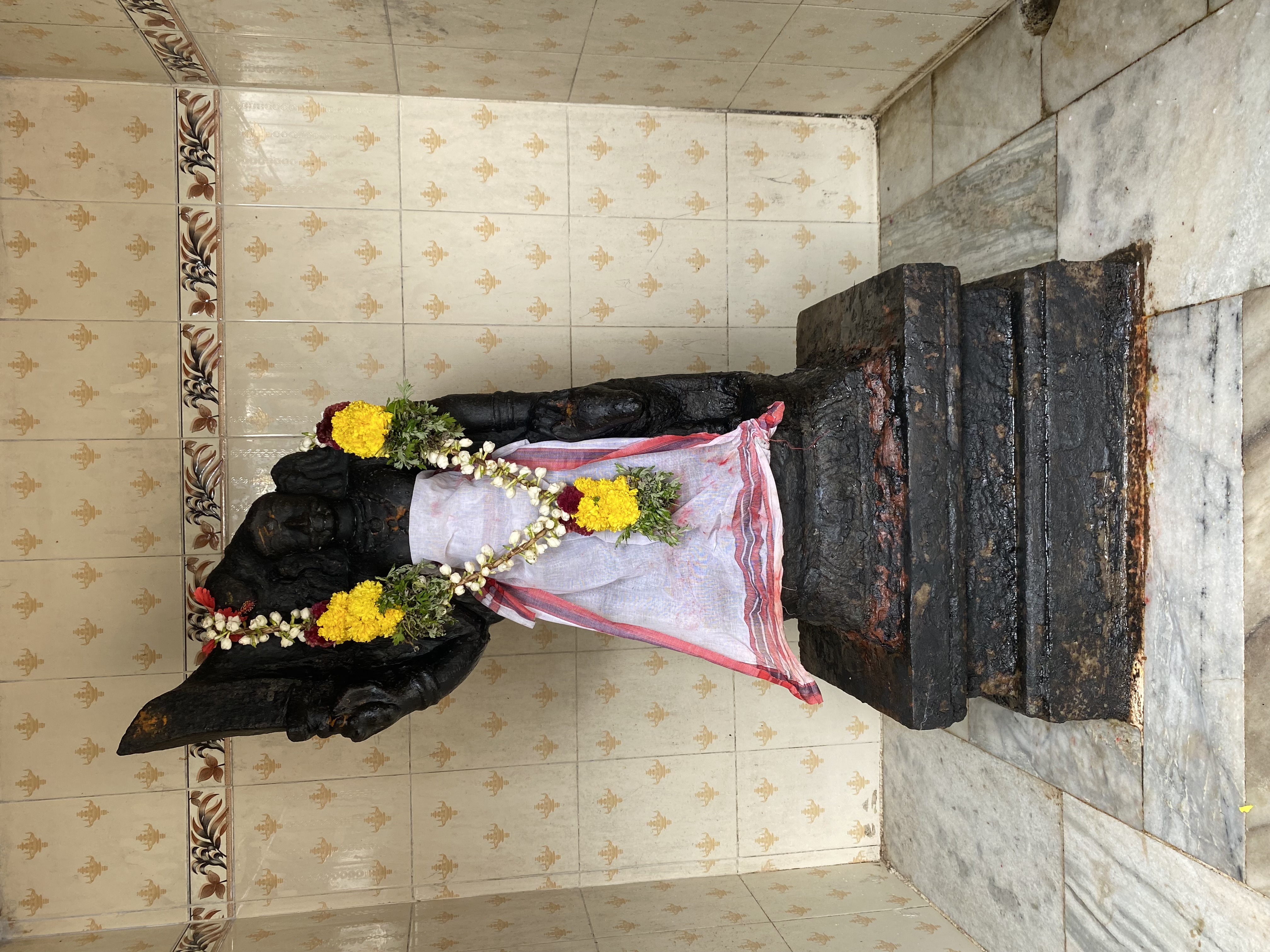
Chinnathambi — literally "the young brother" (chinna = small; thambi = younger brother) — is the most approachable deity in the court. While guardians are fierce and main deities are majestic, Chinnathambi is the friendly one devotees approach for everyday requests: a child's health, a journey to go well, a small business to succeed. He is felt as family rather than distant cosmic authority. His name contains the core of Tamil familial theology: even the divine can be a younger brother — approachable, warm, and present in ordinary life.