Origin and Avatars
Sri Nedungkaval Udayar Dharmashastha is characterized as "the Great Long-standing Guardian," born from the divine union of Lord Vishnu and Lord Shiva. He embodies cosmic righteousness and is accompanied by his consorts Pushkala and Poornakala, along with Lord Vinayagar and Lord Shiva — forming a complete divine assembly of Dharmic authority over the Kootuvuravu.
Who is Sri Dharmashastha?
Sri Dharmashastha, also known as Sastha, is a significant deity revered across South India — particularly in Kerala and Tamil Nadu. He represents divine righteousness, cosmic order, and spiritual guidance. 'Dharmashastha' means the master of dharmic law — the one who governs, judges, and upholds cosmic order with absolute fairness.
Vedic References
The scriptures establish Sastha's supreme position. The Yajur Veda declares: "Sastha is the supreme ruler of all beings." The Maithrayani Upanishad equates Sastha with Brahma, Vishnu, and Shiva — recognizing him as the synthesis of creation, preservation, and dissolution.
Puranic Origin
According to Hindu mythology, Sri Dharmashastha was born from the union of Lord Vishnu (in his Mohini avatar) and Lord Shiva, to establish dharma in the universe. This unique dual-deity origin makes him Harihara-putra — son of both Hari (Vishnu) and Hara (Shiva) — transcending the boundary between Vaishnavism and Shaivism, symbolizing the unity of all divine forces.
The Story of His Divine Birth
When the cosmic ocean was churned (Samudra Manthan) to obtain the nectar of immortality, the demon Mahishi threatened to destroy the universe. The Gods prayed to Lord Vishnu and Lord Shiva for a being powerful enough to vanquish this evil. In answer, Dharmashastha was born — combining the full strength of both supreme deities — created specifically to uphold dharma and protect all devotees from evil.
The Mission: Slaying of Mahishi
Dharmashastha's primary mission was the slaying of Mahishi — the demoness who had received a boon that only the son of Vishnu and Shiva combined could kill her, a being that could not exist in the natural order. His victory over Mahishi symbolizes the eternal triumph of dharma over chaos and evil.
The Eight Forms — Ashta Shasta
Dharmashastha manifests in eight divine forms known as the Ashta Shasta, each offering distinct blessings:
Divine Consorts: Pushkala & Poornakala
Dharmashastha is accompanied by two divine consorts. Pushkala Devi ("the full one") represents abundance, prosperity, and fulfillment of worldly desires. Poornakala Devi ("the complete one") represents spiritual completeness and liberation. Together they represent the full spectrum of blessings — from worldly prosperity to ultimate moksha.
Iconography and Symbolism
Dharmashastha is typically depicted seated in yogic posture (yoga pattasana), right hand in abhaya mudra (protection) and left holding a vessel of nectar. His vahana is not a single mount but a complete parivāra vāhana maṇḍala — consecrated elephants as the chief vahana, Nāga serpent stones in the inner ring, and Bhūta-Gaṇa spirit-forms in the outer ring, arranged in three concentric protective circles. His appearance combines the golden radiance of Vishnu with the fierce grace of Shiva, reflecting his dual divine origin.
Dharmashastha in Tamil Tradition
In Tamil tradition, Dharmashastha is the ancient Dravidian Shastha — rooted in the earliest layers of South Indian spiritual practice, predating Sanskritic traditions. In Tamil Nadu village temples he is called upon to resolve disputes, protect communities, and ensure cosmic balance. At this temple, as Position #1 of the Kootuvuravu, he presides over all 21 divine beings — the supreme dharmic guardian of the entire sacred assembly.
The Sacred Vāhana Maṇḍala
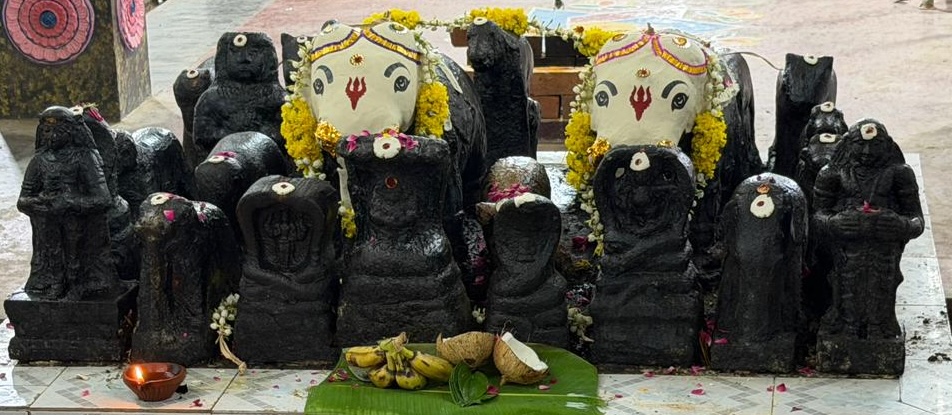
At Sri Nedungkaval Udayar Dharmashastha Temple in Kadayam stands one of Tamil Nadu's most extraordinary and ancient sacred installations — a complete parivāra vāhana maṇḍala: a living guardian assembly of elephants, serpent stones, and spirit-forms arranged in concentric protective circles. These blackened stone figures represent a cosmological worldview preserved since ancient times: Dharma is not protected by one divine will alone, but by an entire field of sacred energies — ancestral, elemental, directional, and spiritual — all united in service of righteousness.
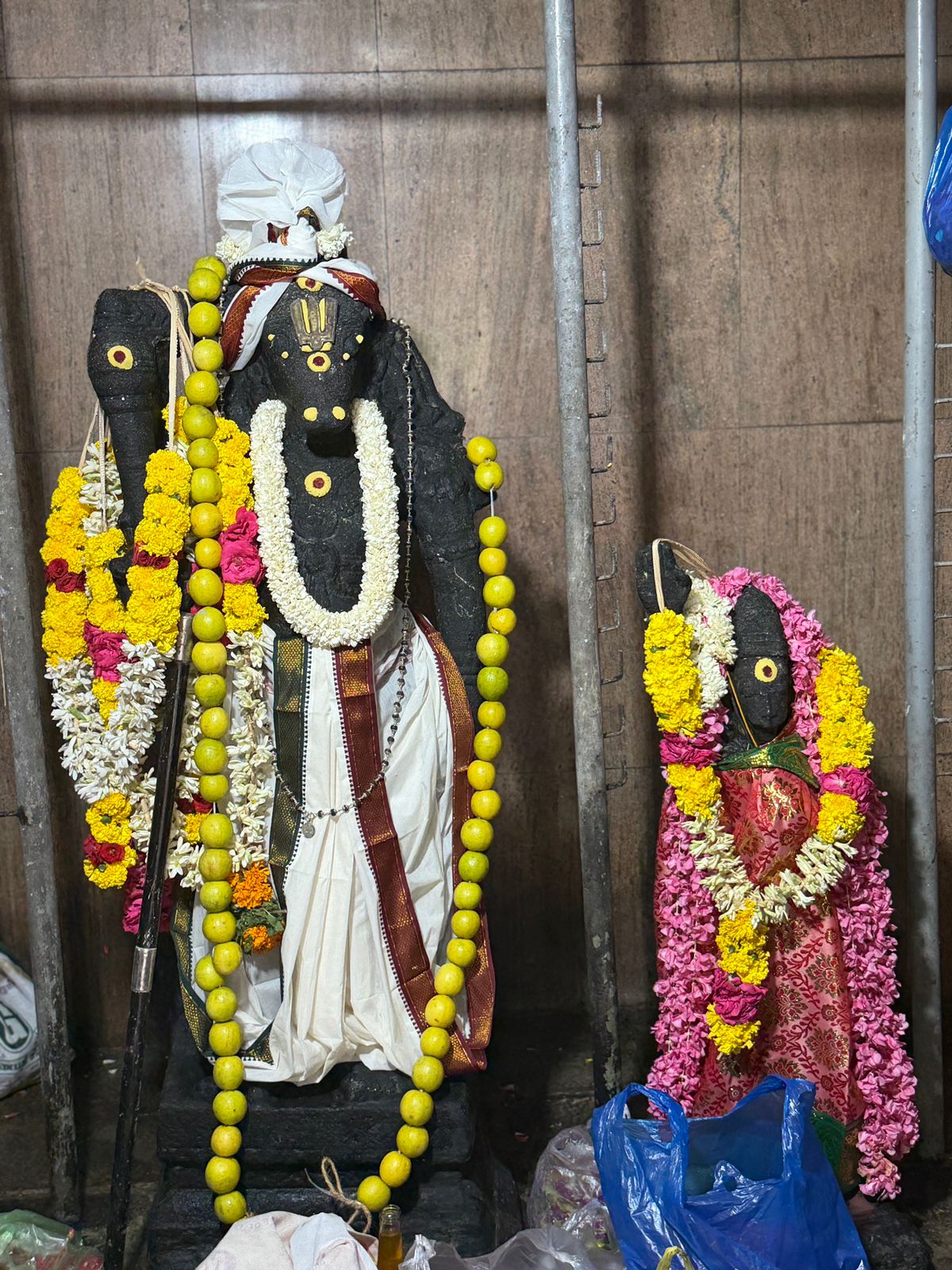
Two consecrated elephants — garlanded, tilaka-marked, daily worshipped — embodying five sacred principles: royal dharmic authority, strength in righteous restraint, eternal cosmic memory, forest sovereignty (Pothigai Hills connection), and eight-directional protection.
Upright serpent stones in silent permanent vigil, guarding four dimensions: land fertility, ancestral lineage (pitru-rakṣā), agricultural abundance via water (Tamirabarani River), and custodianship of ancestral souls. For Kula Deivam families, these stones guard the unbroken thread of ancestral blessing.
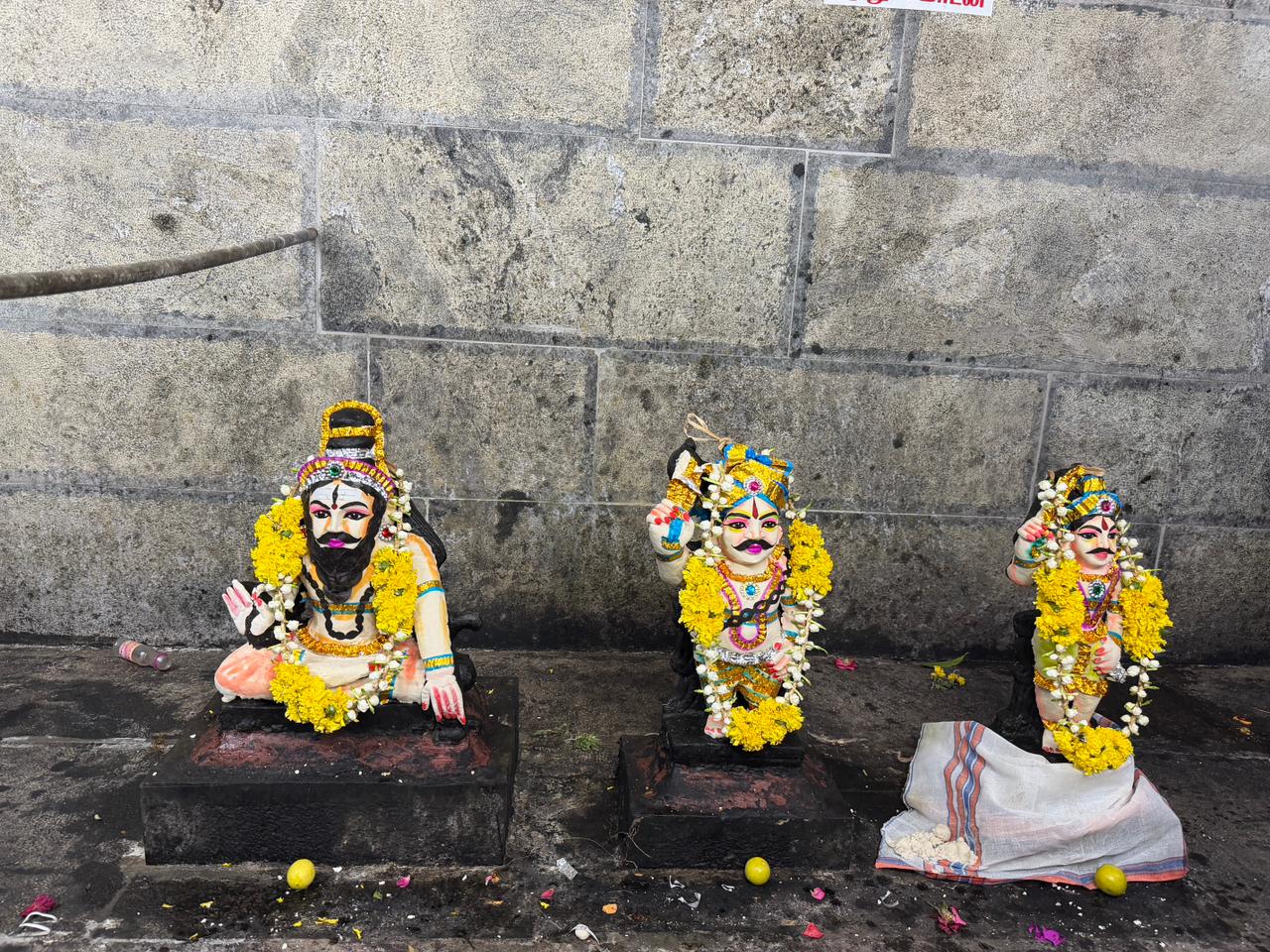
Primal spirit-forms under full dharmic authority. Bhūta means 'existing being' — not malevolent spirits but forces pledged in service to the deity. The Kṣetrapāla protect sacred boundaries, absorb and neutralize negative energies before they reach the sanctum, and maintain continuous night guardianship. Every devotee who crosses this field is consecrated by the passage.
The deep black surface of every figure is the accumulated residue of centuries of unbroken worship — oil abhiṣeka, lamp soot, turmeric, kumkum, sandalwood paste. In Āgamic theology, this blackness embodies the ugra-devatā tattva: the guardian who sees in all directions simultaneously, without fatigue. It is the record of your ancestors' devotion.
Explore the full theological depth of this sacred installation — the three circles of protection, the four converging traditions, the cosmological background, and how to approach as a devotee.
Explore Vāhana Maṇḍala →Sri Dharmashastha Sharanam — We take refuge in the divine dharma. May his grace guide us on the righteous path, protect us from evil, and lead us toward liberation.